By Seth Truscott, WSU Insider
Washington State University students used paintings, digital videos, sculptures, and found materials to express how their high-tech field helps humanity and nature in the Department of Biological Systems Engineering’s (BSE) recent Visionary Roadmap Art Competition.
Launched last fall by BSE chair Manuel Garcia-Perez and student leaders in WSU’s Biomass Engineering Club, Agricultural Automation and Engineering Club (AAEC), and American Society of Agricultural and Biological Engineers (ASABE) chapter, the competition was open to doctoral and master’s students in the department.
“Our goal was to create a vision that captures who we are as a department, what our aspirations are, and why our work is vital to serving our community, the agricultural industry,” said first place winner Martin Churuvija, a BSE doctoral student and AAEC club member.
BSE faculty, staff, and students ranked anonymously posted creations online. All works will be displayed publicly at L.J. Smith Hall on WSU’s Pullman campus.
“I wanted students to reflect on the work of the department and create an art piece that touches the heart, and they exceeded my expectations,” Garcia-Perez said. “Good engineers use the resources and tools learned in educational settings and in daily experiences to solve practical problems. It was wonderful to see them translating their technical and scientific experience into a language that speak to our common humanity.”
Churuvija earned $500 for his artwork, “A Mandala of Cougspiration.” Combining hand-drawn forms with watercolor, it features a view of the Pullman campus’ iconic Bryan Hall clock tower as well as a WSU Coug head logo at the center of an intricate wheel of insects, plants, robots, chemical formulas, and other symbols.
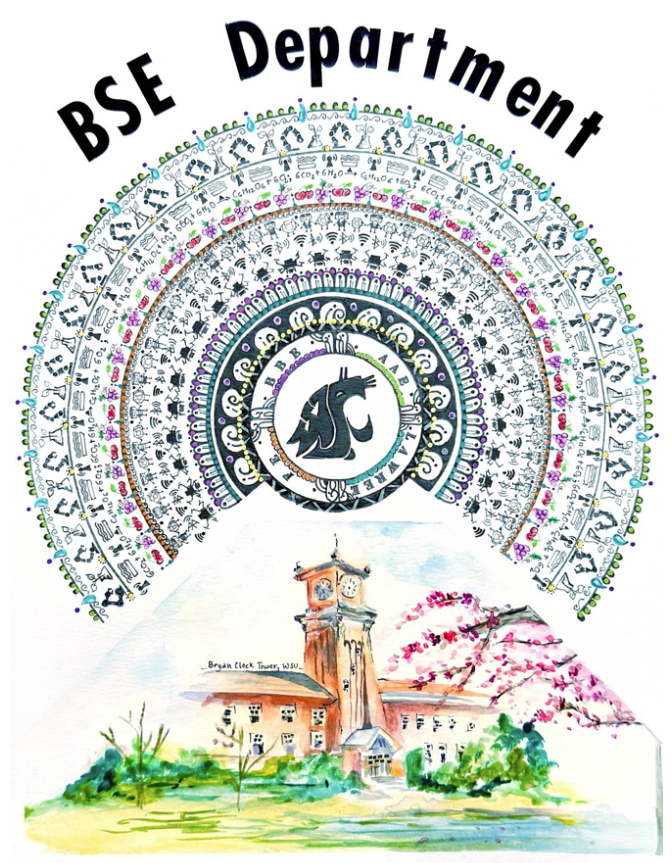
Patterns surrounding the logo represent the interconnectedness of the department’s disciplines, including food engineering, automation, land, air, and water and the environment, and bioenergy and bioproducts. The art, Churuvija said, communicates BSE’s dedication to innovation and collaboration that creates a sustainable future through engineering and biological principles.
“This piece is inspired by my exposure to Indian culture, particularly through conversations with my two Indian roommates,” he said.
In India, Mandalas symbolize balance, interconnectedness, and the universe.
“As a researcher in agricultural engineering, I use both science and creativity to develop innovative solutions for complex problems,” said Churuvija, who is originally from Argentina. “My life project is to provide means to reduce the cost of healthy meals, which is why I am pursuing my graduate studies in agricultural robotics at WSU.”
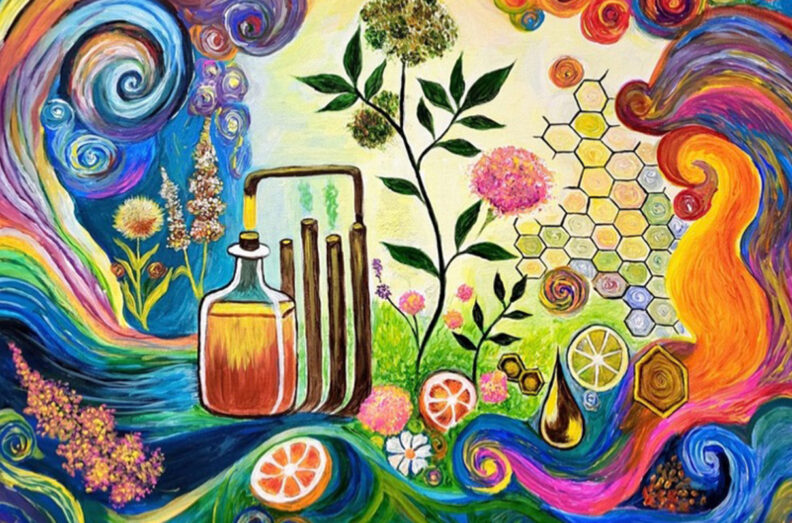
Winning $400 and second place, Anika Afrin painted “Cornucopia,” a colorful composition juxtaposing natural forms like plants and fruits with geometric shapes and lab equipment. Afrin sought to capture how nature provides us with resources that can be utilized to build a colorful and vibrant future.
“My doctoral work inspires me to build a sustainable future full of life and color,” she said. “Through this artwork, I tried to portray the future that I envision — using my research as a gift to the generations that follow.”
Hailing from Bangladesh, Afrin expects to graduate in spring 2025.
“My research focuses on unveiling the complex chemical nature of bio-oils, much-needed sustainable alternatives to fossil fuels,” she said.
Self-taught in art, Afrin had only made paintings to decorate her home or as gifts for family and friends.
“This time, I took a bold step and wanted to showcase my art to a broader audience,” she said. “I challenged myself to sharpen my skills and produce something related to my other passion: the research I do in BSE.”
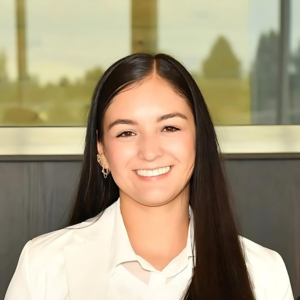
Winning third place and a $300 prize, doctoral student Valentina Sierra created a mixed-medium sculpture titled “Harvesting Hope: Advancing Sustainability Through Unity.” The sculpture shows clasped human hands — resin casts of Sierra’s hand and her husband’s — emerging from a layer of leaves, which she gathered in a diversity of colors and shapes from October through December in Pullman.
Originally from Medellín, Colombia, Sierra will graduate in May 2025. She studies ways to enhance carbon conversion from biomass, improving the efficiency of the process and producing biochar that can be used in many applications, from soil amendments to wastewater treatment.
“I aimed to highlight how women and men collaborate within the department to drive progress in the field, working together to enhance agriculture, ensure food security on multiple levels, and improve the development of sustainable fuels,” Sierra said. “I envision a future where art and engineering continue to merge to foster innovation and a deeper understanding of agricultural and biological systems.”
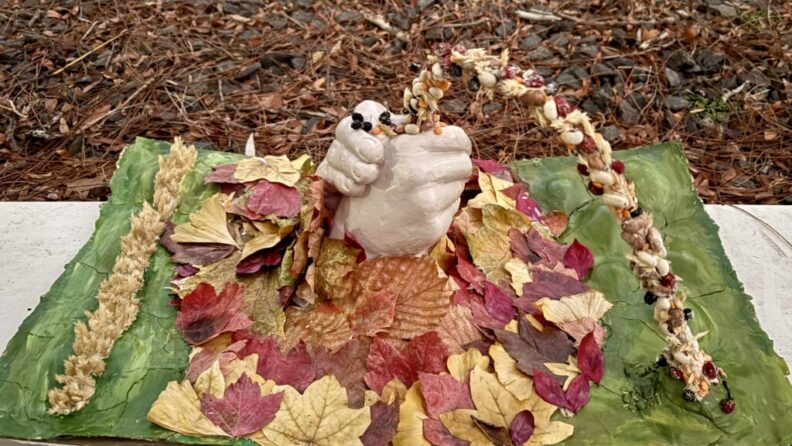
For the piece’s base, she sculpted rolling hills of the Palouse in clay. The hands support an arch of repurposed metal coated in clay, which Sierra pressed with an assortment of grains to make a textured, organic surface. Hands and base are colored using paints left over from other projects, reinforcing her theme of sustainability and resourcefulness.
Other entrants received $100 prizes for their paintings and displays, including Dawood Ahmed, Mohammad Mezbah Hoque, Atif Asad, Micaela Peralta, and Syed Usama Bin Sabir.