By Levi McGarry, College of Arts and Sciences
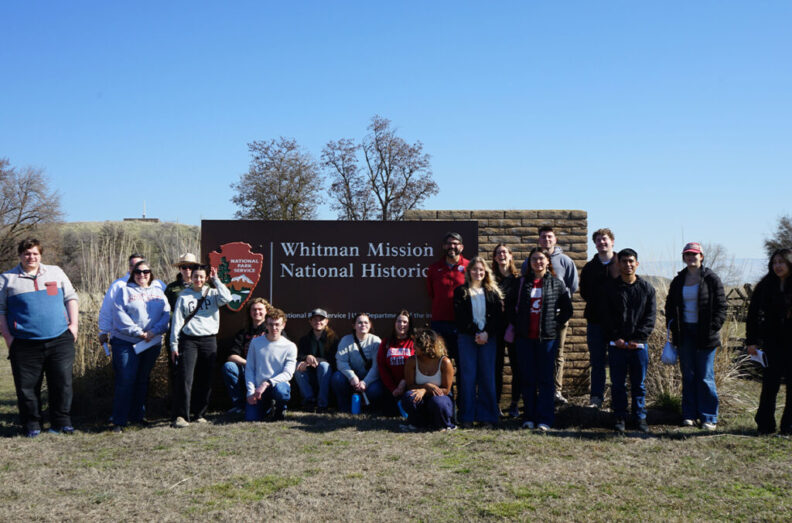
Twenty-five history students visited the Whitman Mission National Historic Site and Treaty Rock of 1855 as part of their courses at Washington State University. “We’re exposing our students to the fact that how we tell stories depends on whom we get the stories from,” said Ryan Booth, assistant professor of history. “When we only tell them from one perspective, we only get one angle.”
Faculty members Ryan Booth and Katy Whelan led their classes to Walla Walla for the field trip on Saturday, March 1, which featured guided presentations by the National Park Service on how exhibits and interpretive signs are utilized to relate the complex histories of the sites. Additionally, the students visited the site of the 1855 Treaty of Walla Walla on the Whitman College campus and were served a special meal of ‘first foods’ provided by Whitman College.
Booth noted that the 1855 Treaty of Walla Walla was an important site and location for the history of relations between the Native nations of the Columbia Plateau and the federal government. He also noted the significance of the Whitman Mission National Historic Site. “The Whitman Mission has been a really important site in our state’s history,” said Booth. “It’s a story with multiple layers and contexts and is really beneficial for explaining to history students how narratives change over time.”
These field excursions are a much-desired return to the public history roots at WSU. Public history involves utilizing historical techniques and methodologies for practical applications found outside of academic research, and public historians engage in historic preservation, museum and archival administration, and research for government or corporate clients. The Department of History first began offering graduate degrees in public history in the fall of 1979. Since then, many WSU alumni have gone onto professional careers in state and federal agencies, including Robert Sutton, retired chief historian of the National Park Service. While the Department of History has a long legacy of promoting public history programs, the Covid pandemic put a halt to several efforts. In 2023 Professor Booth and his students initiated the first history field excursion in years, visiting the Steptoe Battlefield and Cataldo Mission.
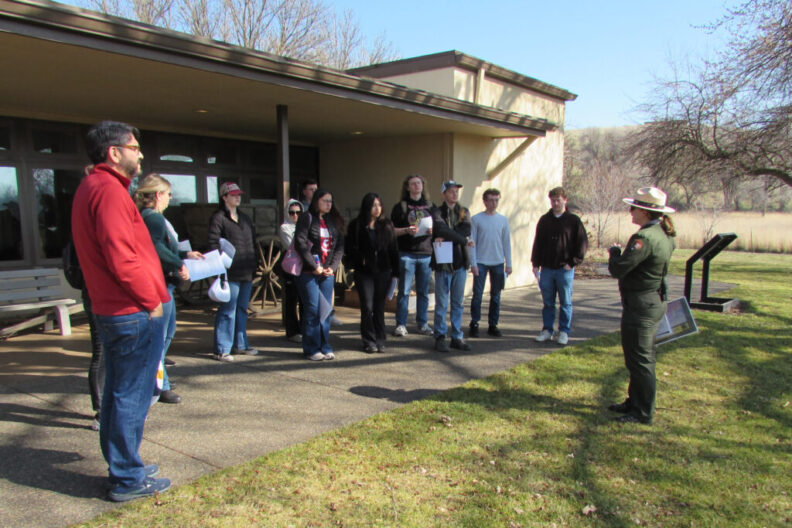
One of the key reasons behind restarting field excursions was to show how historical literacy is critical for contextual understanding and comprehension. “We want to go beyond the classroom and have these kinds of experiences, seeing how history is communicated to the broader public in museums, libraries, archives, podcasts, even those highway interpretive signs,” said Booth. “There’s a real hunger for those types of applicable knowledge and experiences from our students.”
T.J. O’Sullivan is a junior majoring in social studies education who plans to pursue a high school teaching career. Enrolled in classes from both Professor Booth and Professor Whelan this semester, he said that the trip was a fun yet eye-opening learning experience. “My favorite part of the day was walking around the Whitman Mission and reading the history of the Cayuse people,” said O’Sullivan. “Being able to see local history is much more valuable than what you would learn from a textbook.”
The Department of History plans to continue these excursions as time and finances permit. Booth notes that there are plenty of additional historical locales in the region to visit. “I really would like to take some students down to the Spaulding Mission National Historic Site in Lapwai, as well as the White Bird Battlefield,” said Booth. “I’m also interested in taking students to visit Fort Spokane and other places in the area with histories to explore.”