By Communications staff, WSU Insider
Washington State University’s Master of Fine Arts program is carefully forging a broader path for the Pacific Northwest, offering an interdisciplinary haven for artists and a crucial gateway to arts education that recognizes the diversity of the region.
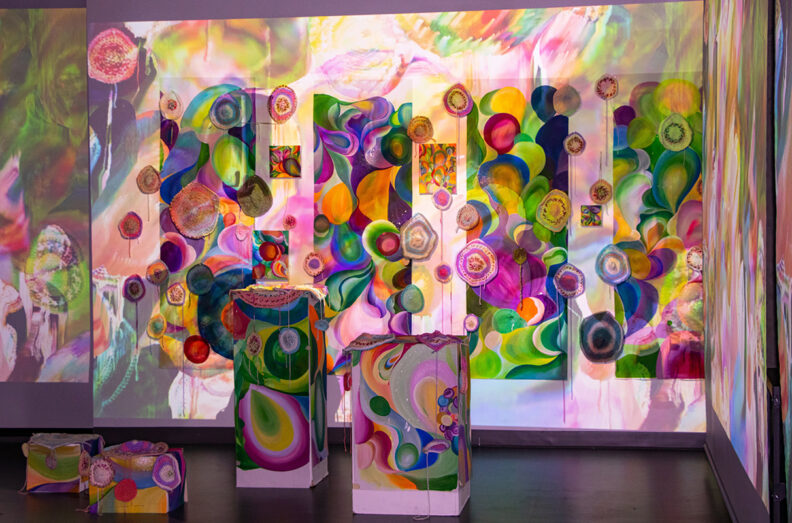
While the annual MFA Thesis Exhibition, currently on display at the Jordan Schnitzer Museum of Art WSU, highlights the culmination of years of intensive work by graduate artists, the program’s impact extends far beyond those gallery walls.
It helps spotlight the vital role the graduate program serves in Washington’s creative economy, a sector that contributes nearly $120 billion annually to the state’s GDP. Graduates fill teaching positions and technical roles across the state, driving innovation and cultural enrichment. “Creative activity is a kind of research,” said Joe Hedges, assistant professor of art. “Just like scientists, artists generate interesting questions and then chase answers through exploration and experimentation.”
Notably, the WSU approach is the only program in the state to actively integrate artists across disciplines such as ceramics, drawing, painting, photography, printmaking, digital media, and sculpture.
“We are this small but mighty hub for people to have access to artistic spaces and possibilities,” said Squeak Meisel, professor and chair of the Department of Art. This cross-pollination of mediums, from ceramics to digital media, fosters an environment where students are encouraged to explore and redefine their artistic boundaries.
Creative activity is a kind of research. Just like scientists, artists generate interesting questions and then chase answers through exploration and experimentation.Joe Hedges, assistant professor
Washington State University
The program’s reach is particularly significant for first-generation and rural students, a substantial portion of WSU’s population. Meisel, who experienced the transformative power of a land-grant university firsthand, emphasizes the program’s role in democratizing arts education. “They’re reaching a lot of students from rural environments that didn’t have formal arts education, and they get to be some of the first people that teach these art students,” Meisel explained.
The partnership with WSU’s nationally recognized museum provides invaluable opportunities for students to engage with contemporary art and visiting artists.
Anna Le, for example, is an MFA candidate whose work blends traditional drawing approaches with video art performance and technology. “I’m curious about how technology influences our behavior, our perception, and our identity,” Le said. She highlighted that WSU’s emphasis on collaboration has helped her find community with other artists and faculty, as graduate students often work and confer with visiting artists to the JSMA WSU.
Abigail Nnaji, an MFA candidate in sculpture, was also drawn to the program because of those community connections. “The visiting artist program where artists from other fields and with other experiences come to campus and hold one-on-one sessions are really helpful,” she said, citing the studio spaces and insightful instruction from faculty members as additional benefits from the program. “When you get to the MFA program, it changes your thinking and helps you to expand on what you know.”
Keegan Baatz, an MFA candidate and instructor, highlights the impact of bringing students to the museum. “Our students can see works that they’ve only heard about or seen on a screen, which is incredibly valuable.”
The 2025 Master of Fine Arts Thesis Exhibition, which opened on March 25, runs through June 28. The MFA Thesis Artist Talks will be held from 3 to 4 p.m. Friday, April 4, with the MFA Opening Reception immediately following. For more information, visit the exhibition website.