By Levi McGarry, College of Arts and Sciences
As technology rapidly advances, a group of Washington State University researchers and students are looking at how wearable devices, smart home systems, and even artificial intelligence can support older adults experiencing neurodegeneration and dementia.
The research at the WSU Neuropsychology and Aging Laboratory (NAL) focuses on compensatory strategies through assistive technologies, prevention advocacy, and brain health education. Maureen Schmitter-Edgecombe, a Regents Professor in the Department of Psychology, is the NAL’s principal investigator.
“For most neurodegenerative disorders, medications don’t stop or roll back the disease progression,” she said. Data suggests that up to 45% of dementia cases could be eased by improving brain health practices, like establishing healthier sleep routines, lowering blood pressure, or addressing environmental risk factors.
Since neurodegeneration isn’t reversible, research projects at NAL focus on using technologies to understand how older adults with cognitive challenges navigate their daily lives. This work involves close collaborations with Diane Cook and her team in WSU’s School of Electrical Engineering and Computer Science (EECS). Many of these interdisciplinary projects integrate undergraduate students within the research plans.
Maya Alger is a senior majoring in psychology who became an NAL research assistant during her second year at WSU. “I was looking for faculty within the psychology department that did research with older adults for my Honors College thesis,” she said. Alger became involved with the NAL’s Electronic Memory and Management Aid, or EMMA, application.
The EMMA app helps older adults compensate for cognitive difficulties by serving as a daily planner and digital assistant. Housed on an iOS tablet, the app allows users to track key health-related activities such as medication use, fatigue levels, and physical activity. Participants across a continuum of cognitive difficulties learn to use the app through an adaptive, web-based training program.
In prior research, Schmitter-Edgecombe’s team assessed individuals in a laboratory environment, which might not accurately reflect the subject’s daily experience. The researchers also relied on self-reported accounts, which can be influenced by the subject’s stress level or memory limitations.
The data captured by the EMMA app provides valuable information for personalized interventions and assistance. The research team also uses smartwatches to collect in-the-moment cognitive testing data, as well as contextual information like fatigue levels, current activities, and amount of environmental distraction.
“These technologies allow us to better capture real-world behaviors, support individuals in their daily settings, and monitor for health changes,” said Schmitter-Edgecombe. “One of the many reasons I was so excited to work with computer scientists and engineers is because in our intervention work, we’re not trying to change cognition but rather improve how a person functions in their everyday environment.”
Luiz Takahashi Dos Reis is a junior in computer science who had been conducting artificial intelligence (AI) research at the University of São Paulo, but felt something missing from his work. “I kept thinking about what this this technology is actually for, and who it helps,” he said.
At NAL, Dos Reis became involved with a project utilizing smart home sensors to passively monitor a person’s cognitive health. The recently-concluded five-year study transformed individuals’ residences into smart homes with motion sensors and other devices to track how they function in their daily lives.
“When I came to WSU, I specifically sought out research that connected AI to real human needs,” said Dos Reis. “The NAL was a perfect fit because it sits at the intersection of computer science and clinical neuropsychology.”
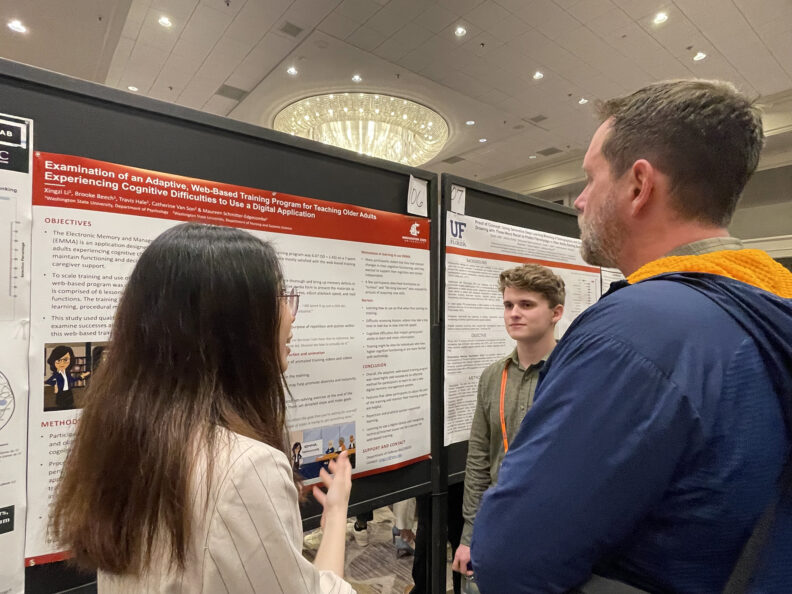
Several NAL undergraduates had their research presentations accepted to the International Society of Gerontechnology Conference, to be held in Vancouver, Canada, in March 2026. Travel for those students is supported through a National Institute of Health (NIH) R-25 grant, which has assisted research education activities for WSU undergraduates in the behavioral, medical, engineering and computer sciences for nearly ten years.
“It’s a wonderful opportunity for undergraduates to experience this interdisciplinary nexus between aging and technology,” said Schmitter-Edgecombe. “Personally, it’s incredibly rewarding to take them to these conferences, and watch them present on their own research project and confidently answer questions from other academic researchers.”
Alger will be presenting her findings from a research project that examined how older adults used daily compensatory strategies. “My lab experience exposed me to the real world of research in a discipline I am passionate about, and solidified my academic plans for a graduate degree in clinical geropsychology,” she said.
The feeling is mutual for Dos Reis. “I’m planning to pursue a PhD in computer science, focusing on AI for healthcare,” he said. “Working at the NAL has taught me that good technology in healthcare isn’t just about accuracy. It’s about transparency, about uncertainty, and about designing systems that enhance human judgment rather than replacing it.”