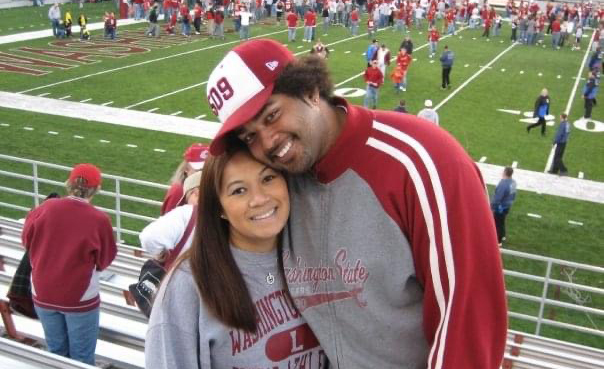
By Keith Powell, WSU Foundation
For Dr. Serign Marong ’02, Washington State University has never been just the place where he earned his degree. It is where his family’s story began generations ago, where he grew up running through campus as a child, and where he later lined up as a Cougar linebacker and biology student. Embedded in every chapter of his life, WSU has remained a constant—one he returned to when seeking the most meaningful way to honor his late wife, Visa.
“I basically grew up as a Coug,” Serign said. “Running around on campus as a little kid, getting into places I probably shouldn’t have been.” Looking back, he remembers Pullman as a place that offered something rare: the closeness of a small town paired with the cultural, athletic, and educational resources of a major university. “It was just a great mix,” he said.
That early feeling of belonging deepened when Serign enrolled at WSU. Athletics provided structure and discipline, but the relationships lasted far longer. Nearly three decades later, he still returns to Pullman with former teammates from his recruiting class. “We came in when we were 18 years old,” he said. “We still have that connection, and we still go back.”
A relationship shaped around WSU
As a scholarship student‑athlete, Serign saw firsthand how opportunity could open doors, and how responsibility came with it. Today, he serves on the College of Arts and Sciences board, continuing a long-standing commitment to the university he describes as “still such a huge part of my life.”
WSU also played a pivotal role in Serign’s relationship with Visa. Though they met after graduation, the university remained central to their early life together. Both worked for Washington State University, and weekends were often planned around Cougar games and campus events. “It was such a huge part of the beginning of our relationship,” Serign said.
Visa Marong was a proud Cougar in her own right, drawn to work that connected people and helped them move forward. After enrolling at WSU in 1997, her career included roles in athletics, marketing, and, later, biomedical research outreach—work focused on helping young people imagine futures in fields they might not otherwise consider. “Her passion was helping other people reach their goals,” Serign said. “That’s where she really found joy.”
Grief, healing, and a guiding question
In March 2014, Marong’s life changed suddenly when Visa died unexpectedly. In the years that followed, grief pulled him away from medicine and from the routines that had previously defined his days. “I was going through my grief process, my grief journey, and a couple of years into it, I was way worse than when it first happened,” he said. “Things were really bad for me. I wasn’t working. I had given up my medical license, my practice. It was not a good time in my life. But I finally started doing some serious grief work.”
As he began rebuilding his life as a father and physician, one question kept surfacing: How do you live in a way that would make someone you’ve lost proud? Over time, that question became a guidepost. “It almost became a ‘what would Visa do?’ kind of thing,” he said. “If I stayed within that, I felt a lot better.”
That reflection ultimately led him back to Washington State University. Born to Lao refugees and brought to the United States as an infant, Visa carried a heartfelt appreciation for community and opportunity. By creating the Visa Marong Memorial Scholarship, Serign found a way to translate love and loss into something enduring.
The endowed scholarship will support students pursuing their education at WSU, carrying forward the values that defined Visa’s life—motivation, generosity, and a belief that where someone starts shouldn’t determine where they’re headed.
For Serign, the scholarship isn’t only a way to remember Visa—it’s a way to make her presence lasting. “Having this sustained and going,” he said, “creates that presence.” It also ensures that Visa’s story doesn’t stop with memory alone. “Somebody down the road will read a little blip about her,” he said. “Who she was. That she was a Coug. And that matters.”
A reminder for the next generation
The scholarship also holds deep meaning for his children. Because they were so young when their mother died, many of their memories come from stories. “This is another way to show them how important she was,” Serign said. “To know their mom has a scholarship named after her—that her life mattered in this way.”
For WSU, the scholarship carries special meaning—established by a former student-athlete and physician who found his way back to the university through grief and chose to leave something behind.
“Serign’s story and that of his wife, Visa, is emblematic of what makes WSU and Pullman so special. That Serign has chosen to honor Visa through a scholarship ensures the Marong family remains part of the WSU community,” said Saichi Oba, vice provost for enrollment management. “Gifts like this are an investment in the potential of future Cougs.”
Today, Serign is back practicing medicine and remains active in the Cougar community. He speaks openly about grief, legacy, and healing—not because those conversations are easy, but because they help others feel less alone. “It’s not about getting rid of grief,” he said. “It’s about making sure it doesn’t stop you from moving forward.”
For Dr. Serign Marong, Washington State University is tied to some of the most important moments of his life. Through the Visa Marong Memorial Scholarship, it is now also a place where Visa’s story continues—told not just to his children, but to every student whose future it helps shape.