By Levi McGarry, College of Arts and Sciences
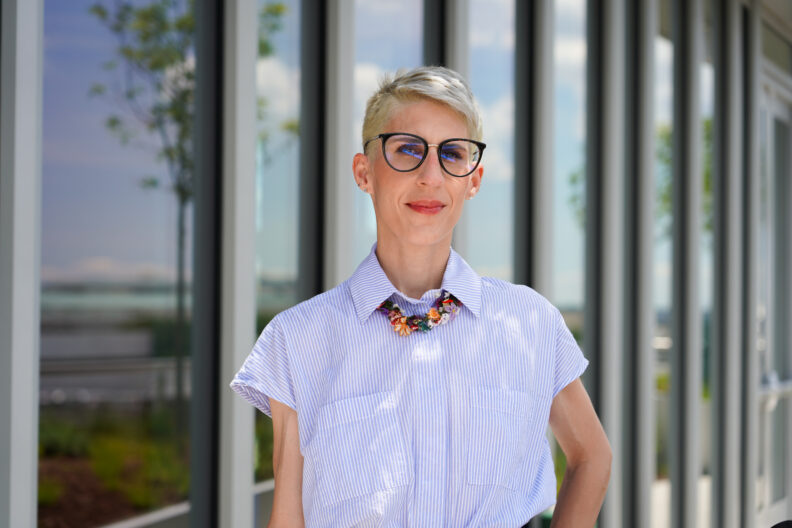
The Thomas S. Foley Institute for Public Policy and Public Service has selected Thessalia Merivaki as the institute’s next director. Professor Merivaki joins Washington State University from her previous position at Georgetown University, where she was an associate professor with joint appointments at the McCourt School of Public Policy and the Massive Data Institute. She is a co-founder of the Digital Trust Lab at the Massive Data Institute and currently a non-resident fellow at the Center for Democracy and Technology, as well as serving on the editorial team of the Disability Policy Foundry.
“I am very excited to contribute to this amazing institute and carry on Speaker Foley’s legacy, which is grounded in community, civility, and commitment to public service,” said Merivaki.
Merivaki’s research expertise covers multiple dimensions of the electoral process, including institutional and administrative frameworks, political communication, voter behavior, and election science. Since 2020, she has co-directed the Election Officials Communications Tracker, a massive data collection and analysis initiative reviewing all state and local election officials’ communication efforts on social media. Merivaki’s work has received funding from organizations such as MIT’s Election Science and Data Lab, the Bipartisan Policy Center, and Public Agenda, supporting her research on identifying best practices in how local and state election officials combat misinformation and build trust in election integrity. Her most recent research has centered on developing frameworks to evaluate how artificial intelligence (AI), specifically generative AI, is viewed within election communications, and how it shapes the broader information environment.
“What keeps me excited about my work is that it offers opportunities for relationship-building with voters, election officials, and the broader democracy community,” said Merivaki. “It is my goal to be part of the community that is working hard to safeguard our democracy, not just study it from a distance.”
Merivaki’s scholarship has been published and featured in Social Science Quarterly, State Politics and Policy Quarterly, Political Research Quarterly, American Politics Research, PS: Political Science & Politics, Election Law Journal, Public Integrity, Policy Studies, Journal of Election Administration, Research and Practice, Social Science Research, The Handbook of Election Administration, and Political Communication.
Professor Merivaki agreed to answer questions submitted to her by the College of Arts and Sciences communications staff; her responses are reprinted in full below.
1. What is your area of research and scholarship?
My research sits at the intersection of election administration, voter communications, and information integrity. I study how policy design shapes how elections are run, and—now more than ever—how election procedures, from registering to vote and casting a vote to counting ballots, are communicated to voters, especially on social media and now through AI-mediated systems. During my tenure at Georgetown, I co-founded the Digital Trust Lab to house that second half of the work: understanding how election officials build (or lose) public trust through the channels voters actually use to find information about how to vote and how elections are kept secure.
2. How do the fields of public policy and digital data interact with each other? How do those interactions affect our democracy and electoral process?
Election administration used to be studied almost entirely as an institutional question—how rules and procedures are designed, and how federalism explains variation in election policy. What became clear to me over the last several years is that even a well-designed, accessible policy fails if voters don’t know it exists or don’t know how to use it. Digital data is where that gap now lives. Through the Election Officials Communications Tracker, my team and I have built the research infrastructure to observe and understand how election officials are closing that information gap in real time. What we observe is that the landscape keeps changing rapidly; it’s no longer just about whether a voter sees a Facebook post about how to request a mail ballot, or how to find one’s polling place. Now, it’s more about what kind of information voters receive when they ask an AI chatbot “how can I vote in my state,” and, “how can I trust election outcomes when prediction markers tell me another person would be the winner?” Public policy has to keep up with how information from these authoritative sources reaches voters through these AI mediated systems, and how technology can be used.
3. What do you personally find most exciting or invigorating about your research? In other words, why pursue this knowledge?
What keeps me excited about my work is that it offers opportunities for relationship-building with voters, election officials, and the broader democracy community: first and foremost, I care deeply about earning the trust of election officials, many of whom start out skeptical of researchers. It is my goal to be part of the community that’s working hard to safeguard democracy, not just study it from a distance. I offer myself as a resource, and I strive to teach my students to consider themselves as part of that community.
4. What has been the topic or framework of your most recent research or work?
Most recently I’ve been writing about algorithmic poisoning and how it has transformed the information environment. Influence operations, which aim to manipulate public opinion, have shifted tactics: instead of building fake websites aimed at human readers, bad actors are now flooding the web with content designed to be scraped by AI crawlers, so that when a voter asks a chatbot a question about their election, the answer has already been quietly corrupted upstream. A lot of this exploits “data voids”—the fact that many state and local election offices, especially rural and under-resourced ones, simply don’t produce enough online content to fill in the gaps, leaving room for AI systems to surface low-quality or manipulated information instead. As I am exploring this research, I am thinking intentionally about which policy and regulatory frameworks are appropriate to minimize the harms to the public, while protecting their first amendment rights.
5. What are your plans or aspirations for the Foley Institute?
I am very excited to contribute to this amazing institute and carry on Speaker Foley’s legacy, which is grounded in community, civility, and commitment to public service. I am in my “Listening Era” at the moment, but I do have big plans for the Institute. My priority is to connect all the Institute’s work on democratic governance under a unifying umbrella, what I call the Democratic Resilience Initiative. It will be anchored in institutional trust, civic education, civil discourse, election integrity, technology, and information integrity. Alongside that, I want to build a Tech and Policy Incubator where students and faculty develop deployable tools in partnership with industry and government, testing new approaches to real problems while safeguarding democratic values.
That vision fits naturally with the College’s Career Ready, World Ready initiative. I want the Foley Institute to be where students get that same kind of experiential grounding—paid internships, mentored policy projects tied to real problems, and hands-on work in the incubator—so that a degree translates into an actual pathway into public service. Underneath all of it is a leadership philosophy I hold firmly: trust is our currency. The goal is a Foley Institute that prepares the next generation for public leadership, helps Washington govern with confidence, and brings people together when politics pulls them apart—while giving students the concrete, transferable skills to be genuinely career ready and world ready when they leave WSU.