By Levi McGarry, College of Arts and Sciences
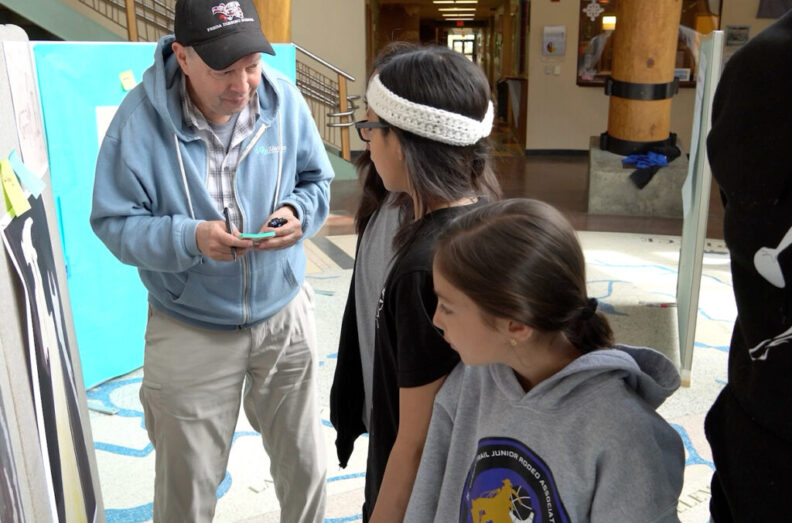
Washington State University’s Michael Holloman recently helped guide Colville Tribal youth as they brought fresh perspectives to a new Clyfford Still exhibition at the Denver Museum, dedicated to the famed artist and former Washington State College faculty member.
Holloman, a professor of art who serves as the College of Arts and Sciences’ coordinator for Native Arts, Outreach, and Education, assisted with planning efforts for the latest exhibition at the Clyfford Still Museum (CSM), “Tell Clyfford I Said ‘Hi’: An Exhibition Curated by Children of the Colville Confederated Tribes,” which opened in mid-September in Denver, Colorado. Featuring Still’s works from and inspired by his time in Washington, the exhibition was curated by schoolchildren in Nespelem and Omak in an effort that was recently profiled by The New York Times.
“Clyfford Still might be our most famous alumni at WSU that most people don’t know about,” said Holloman, who is an enrolled member of the Confederated Tribes of the Colville Reservation. “But in the art world, he’s a giant.”
Still, an American painter who was among the first generation of abstract expressionists, is credited with laying the groundwork for the movement as he shifted from representational painting to abstract forms. He was a faculty arts instructor at Washington State College (now WSU), and helped establish the Nespelem Art Colony, where he taught art in the summers of 1936–38. The experience in Nespelem was foundational to the energy and expressiveness of his later abstract works.
Clyfford Still might be our most famous alumni at WSU that most people don’t know about. But in the art world, he’s a giant.
Michael Holloman, professor
Washington State University
The Clyfford Still Museum in Denver houses 93% of Still’s lifetime of artwork. When the archives were transferred from Still’s estate to the City of Denver in the early 2010s, his collection of drawings and paintings from Nespelem were rediscovered.
“That became the opportunity for me, as a professor and a Colville tribal member, to reach out to them,” said Holloman, who helped establish a working relationship between the CSM and the Confederated Tribes of the Colville. The outreach effort led to collaborative planning between museum staff, tribal leaders, and teachers across the school districts on the reservation.
The resulting exhibition explores Still’s work through the perspectives of children from the Colville Confederated Tribes, some of whom are descendants of individuals portrayed in Still’s artwork. The children aged three to 14 were instrumental in reviewing and selecting artwork, providing object interpretation and arrangement, and drafting gallery texts and interactive experiences.
“The CSM staff created these remarkable reproductions where the children decided which works they wanted to show,” said Holloman. “Some were from Still’s time in Nespelem, but they also included some of his much better-known abstract work when he was becoming quite famous in New York.”
For the exhibition opening, CSM flew families from the tribal community to Denver to witness and celebrate the collaborative effort.
“They were all amazed by the scale of his work,” said Holloman. “They had seen the reproductions, but suddenly they’re standing in front of the original painting that might be 10 feet wide by eight feet high.”
“Tell Clyfford I Said ‘Hi’: An Exhibition Curated by Children of the Colville Confederated Tribes” opened on Sept. 19 and will run through May 10, 2026, at the Clyfford Still Museum in Denver, CO.
Holloman also edited the recently-published “Frank S. Matsura: Iconoclast Photographer of the American West,” featuring the story of a Japanese immigrant whose photographs of Okanagan, Washington, in the early 1900s have become renowned for their authenticity and liveliness.